



Tom Gleason
Small, Well Built and Quiet at Default Settings.
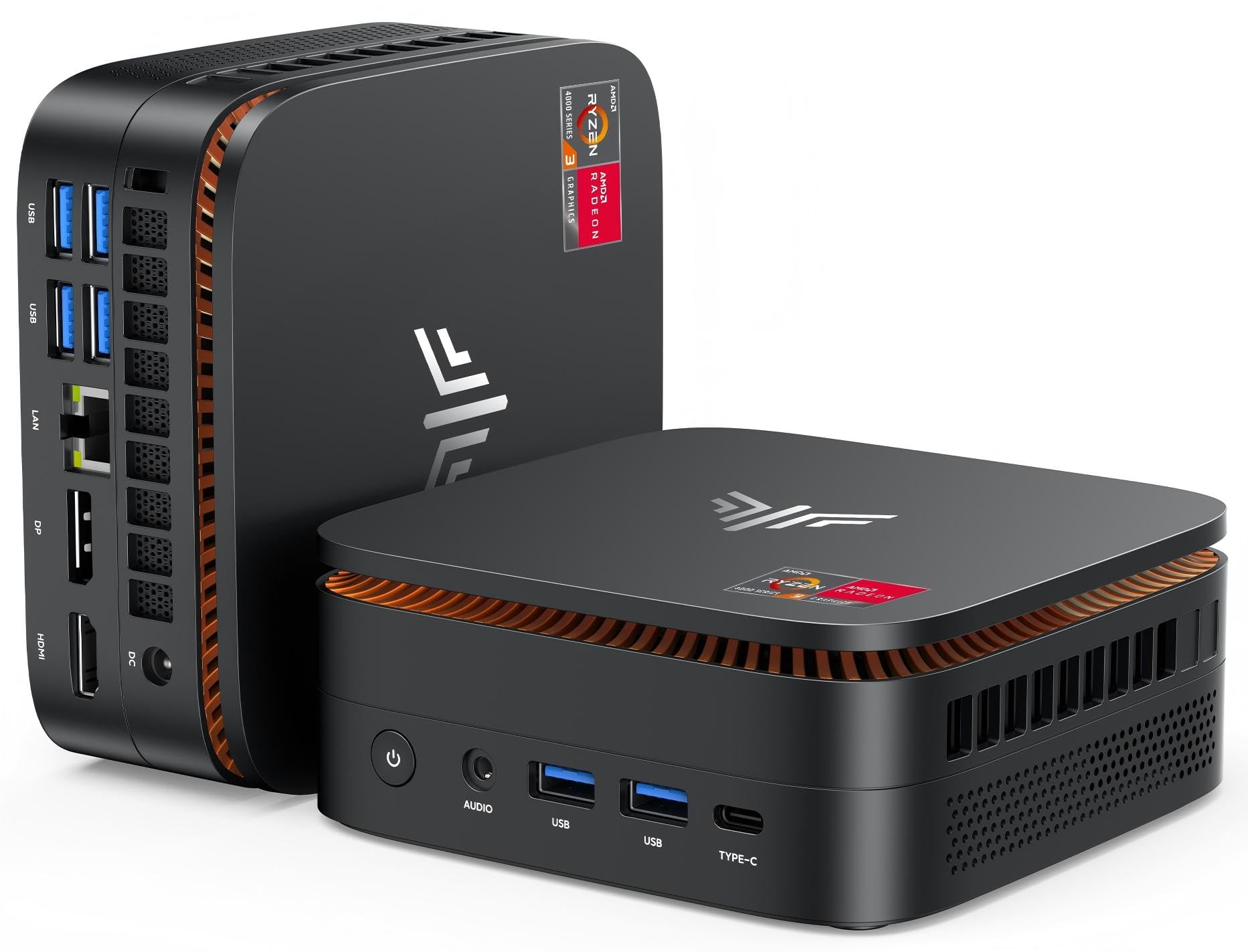
I learned a lot about the Beelink SER 3 hands on and I am happy with the purchase. My use is for Web browsing, 4K video watching and all other kinds of general PC use. I wanted something small, efficient and unencumbered by security cam management and a PLEX server. I moved the Plex server to an HP 8300 i7 (Gen. 3) SFF chassis and the security camera monitoring, management and recording to a Ryzen 5 Lenovo laptop with one external HD for recording 24/7. These applications were all bandwidth killers for me on the original i5 laptop that served me for general computing, security and PLEX. I would have been fine with just doing that, but my i5 laptop was loaded up with 12 USB external drives as media storage. It died (burned up). I had it doing way too much. So now, with my main services back up on alternative devices, my desktop lacked a clean PC for just general PC tasks. The Beelink SER 3 replaced the i5 laptop that died and is running minus the bandwidth eating aforementioned services.I decided to write a review that is helpful to new purchasers. My first recommendation is to the tinkerers like me. If you purchase this, run it as configured! It comes very tuned for snappy general computing. Mine came with Windows 11 already installed. I share a wired USB keyboard, wireless USB mouse, laser printer and scanner on a two way USB switch with the Beelink SER 3 and the HP 8300 SFF i7. Both devices connect via HDMI and miniDP to a Samsung 4K UHD 40" TV. I had problems connecting the Beelink to the Samsung at 4K 60Hz. The problem was my HDMI cable(s). With one cable I was able to achieve 4K 30Hz but the Beelink supports 4K at 60Hz and I wasn't satisfied with 30Hz. The solution was the purchase of a new HDMI cable. I knew onboard Radeon Vega graphics were cable finicky. The HDMI cables that came with Beelink SER were not long enough to meet my needs so they remain untried at 4K 60Hz. I purchased a new 6.6' 8K HDMI 2.1 certified at 48Gbps. This cable worked at 4K 60Hz but produced the occasional blank/black screen (handshakes/re-syncs). This problem was solved by moving the cable away from the numerous power sources it crossed for my external hard drives and the TV's power circuitry inside the TV. Now I'm at 4K 60Hz with no issues. Cables aren't always well shielded and up to claimed specifications. There are also a lot of fakes even on trusted online retailers.It was obvious that with a TDP of 25 watts, I wasn't getting the most out of the Ryzen 7 3750H which is rated to 35 watts. So, I made that change in the BIOS, rebooted and ran a temperature monitor and Geekbench 5. Under load I reached a max temperature of 203 degrees Fahrenheit and the fan, while not constant, really whined at times to lower the CPU temperature. At 35 watts there was actually lower performance on Geekbench 5 than at 25 watts under load due to CPU throttling. The Beelink SER3 cooling solution is designed to run well and relatively quiet at 25 watts*. I wouldn't feel safe gaming on it at 35 watts for long and I believe that doing so would shorten its productive life significantly. It would require a bigger cooling solution and a larger case to support 35 watts under CPU load to maintain a long life.I ordered the 16GB DDR4 configuration. At 25 TDP I tried overclocking my memory. After getting a question answered on DDR4 configuration, I learned that if ordered it that I would receive it in dual channel mode (2 8GB sticks), but GPU-Z said I was in single channel mode! Dual channel memory is the easiest way to gain performance. 60 bucks later I am in dual channel at 32GB. Obviously, my answered question was wrong about the DDR4 configuration. I took a simple approach to overclocking the memory in the BIOS by just adjusting the memory speed. With just about everything set to Auto, I thought my chances were good so I figured if I hit a ceiling that it wouldn't boot and I would have to clear CMOS to get back to the original settings. I was wrong! Both sticks were rated at 3200Mhz (dual channel) and the default setting in the BIOS was 1200Mhz (single channel). I tried 1333 Mhz and 1600Mhz x2 settings for dual channel. Both seemed successful as Windows 11 opened on each reboot. CPU-Z reflected the changes made in the BIOS. However, performance actually declined in Geekbench 5! So, I'm going to have to try some Ryzen overclocking tools and for now, I'm still at the 1200Mhz x2 BIOS setting (2400Mhz, dual). The Geekbench 5 results image posted here shows the best Geekbench 5 score I received while tinkering in the BIOS with the TDP set at 25 watts and 32GB 2400Mhz dual channel memory in Windows 11 high performance mode. Basically, these are the default settings only with an additional stick of DRAM for dual channel speed added.In conclusion, the best improvements you can make initially to the Beelink SER 3 are to insure you have 2 sticks of matched DDR4 for dual channel mode and add a SSD Drive inside the case while you have it opened. I wasn't able to rely on the seller to find out the shipping configuration of the DDR4. I received a single 16GB stick instead of the promised configuration of 2 8GB sticks. It is easy to access memory by removing the 4 bottom screws. There may be future BIOS updates that allow for more incremental control and tuning. Doing this, and making sure Windows 10/11 is set to high performance mode and sleep mode is off, is about all that I would recommend for best performance at this time.*At 25 watts TDP, expect your Ryzen 7 3750H cores to run between 2.3Ghz and 3.4Ghz. It won't make it to 4Ghz at default BIOS settings. These Beelink SER 3 product listings on Amazon should reflect reality and not the CPUs capable performance that they aren't supporting in the settings of their delivered product. Basically, you are agreeing to void your warranty in changing some of the BIOS settings.Ver másVer menos
122 personas la encontraron útil