




Connecticut Fan
Great little tool at a very attractive price - good value!
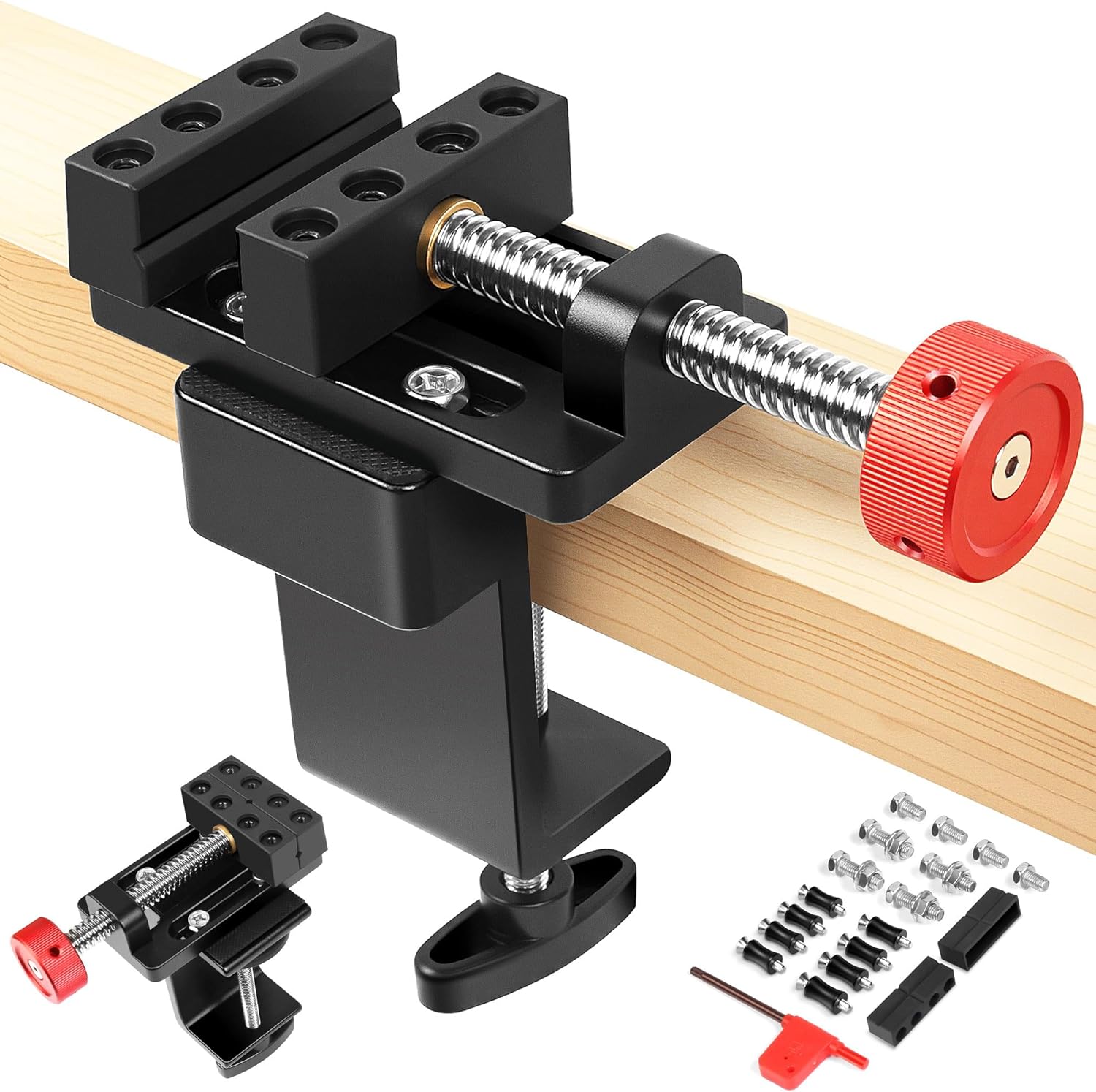
I bought this vise after reviewing many similar items on Amazon. This one had the most positive and least negative reviews, and although it was a bit more expensive than other offerings, it is easy to see why that is, after you receive it. The vice was nicely packaged, with internal pieces inside the small box wrapped to prevent damage, and loose parts in a zip-lock bag. Everything needed was there, including a small but well thought-out instruction sheet.I attached it to a Dremel rotary tool drill stand, and it was easy to do so with the included hardware.I have a few comments that are things not related to this specific model, but generally applicable to all the types of attachment vises of this kind of design.First, you must figure out how to "center" the device so that the drill bit is approximately centered on the vise. The base of the drill press has scribe marks, and the jaws on the vise have a "V" in the center; so that solves the right-to-left centering. The slots on the base of the drill press are diagonal (the four slots form an "X"). Once installed, loosening the attachment bolts allows a 13/16" front to back movement, and/or a 7/16" side to side movement. Since the rear jaw is fixed, centering is necessary on the work piece to get the hole where you want it.The workpiece can either be held by the jaws themselves - there are rubber "boots" that slide over the jaws to cushion the piece and prevent damage. Make sure you orient the "boots" so that the "V" on each faces the center of the vise.There are eight plastic posts and screws to mount to the top of the jaws for non-straight or odd-shaped pieces. You can use all eight for a straight sided piece, or less than eight to accommodate any curvature on something that may be round.You must pay attention to where the hole is to be located - too close to the vice jaws may create interference with the spindle. In such cases, you can use a "spacer" to get the part away from the jaws, or use a longer drill bit (that solution may affect accuracy of the hole location and hole size, and care must be taken to not have a long drill bit at high speed that can snap under pressure). Mark your drill location on the work piece with a center punch so you get accurate registration.The maximum work piece that will fit between the jaws with the rubber boots installed is about 2 ¼". Using the pins on top the maximum is 2 ½".The so-called "red flag" is actually a #20 Torx wrench that serves two purposes. First, it tightens the screws that hold the plastic posts on the top of the jaws, and second it is a lever to insert into the knurled knob to tighten or loosen the clamp on the workpiece. Nice adder - and kudos for using the same tool to do two jobs.The bolts that hold the vise to the base are Phillips-head on the top and 10mm on the nuts underneath. You don't need the 10mm wrench, though, as once finger tight they dig in and you can tighten them from the top. And that is a bit of a pain, as it would be for any vise on a Dremel drill stand. There is nothing on the bottom to prevent the nuts from spinning freely when loose. If you loosen them to move the vice, you must hold them until you get finger tight and can finish the job with a Phillips head screwdriver. It's tedious, and I can't imagine a better way to do it - larger drill press bases have deep walls around the slots underneath and use "T" bolts that won't turn therefore they don't need a wrench or anything else to hold them steady. Perhaps a properly-sized "T" nut instead of the round 10mm nuts would help. I'll be researching these.Yes, this is rather long review for such a low-priced item, but it's clear this is a real quality piece that makes drilling small holes very accurately, an easy task. When installed on the Dremel drill press attachment, you have a tool that will do for model building what would cost hundreds of dollars if you opted for a different solution. I can drill a hole 1/16" diameter through a small steel plate used as a weight on a model railroad train, 1/16" from the edge, leaving only 1/32" wall. Try doing that by hand!NOTE: The pencil marks on the drill press base I put there to get good alignment of the vise.UPDATE: I was able to buy T-Slot nuts that fit the Dremel base perfectly. Once you replace the supplied hex nuts, you no longer have to turn the drill press over when you move the vise around the base for precision location. The nuts are defined as "8 mm slot, M6 x 1 mm thread" and the supplied bolts will fit in them perfectly. The ones I found are under $3.00 each, so about $12.00 total to replace the hex nuts. These are steel. The stainless 8mm M6 x 1 are a bit pricier - about $7 each or $28 for all four. T-Slot nuts are quite expensive, but make the adjustment of the vise on the Dremel table almost effortless.Ver másVer menos
5 personas la encontraron útil